
At large
Orland voters choose among candidates citywide for the council seats on their ballot. Candidates can live anywhere within city limits.
A community guide to council elections
Orland began drawing council districts in 2025. The November 2026 election was still citywide. Explore the proposals, see how the council voted, and find out how to have a say.
01 / Representation
The difference is who votes for each seat and where candidates live.
Orland voters choose among candidates citywide for the council seats on their ballot. Candidates can live anywhere within city limits.
Each of five districts would elect one councilmember who lives in that district. Residents vote for their district’s seat when it is on the ballot.
City of Orland districting overview
We support a recorded council vote to complete a lawful transition to five districts, with a public explanation of the remaining issues and a timetable coordinated with Glenn County. We believe district elections would make it easier to run a neighborhood campaign and give more parts of Orland a direct voice.
A study of California cities found that after switching to districts, more candidates and councilmembers came from lower-income neighborhoods and neighborhoods with more renters. Orland’s results would depend on its map, candidates, and voters. Read the study.
Results are checked hourly and will automatically update here as Glenn County publishes new vote counts, until the election results are certified.
Glenn County’s November 9 unofficial report lists John McDermott first, Alex Enriquez second, Andy Ramirez third, and Sharon Lazorko fourth in the race for two full-term Orland City Council seats. The margin between second and third place is 11 votes.
| Place | Candidate | Votes |
|---|---|---|
| 1st | John McDermott | 1,082 |
| 2nd | Alex Enriquez | 719 |
| 3rd | Andy Ramirez | 708 |
| 4th | Sharon Lazorko | 664 |
All 23 precincts have reported. The results remain unofficial until the county certifies them.
Fifth Unofficial Report, November 9, 2026, page 7 (PDF) · Glenn County Elections results
Glenn County released unofficial election-night returns on November 3 for the race for two full-term Orland City Council seats. The four candidates were Alex Enriquez, Sharon Lazorko, John McDermott, and Andy Ramirez.
This archived report reflects the count at that time, not a final result. See the November 9 update above for the more recent totals presented on this page.
Glenn County election-night returns, page 6 (PDF) · Glenn County Elections results
02 / Public record
Follow the City Council’s votes, public hearings, and draft maps from the resolution of intent through the 2026 election.
The Council voted 5–0 to adopt Resolution 2025-20 and directed staff to prepare a hearing schedule and recommend when to start district elections. December 2 Council minutes (PDF)
The Council voted 4–0 to approve an agreement with National Demographics Corporation for maps, demographic analysis, and public outreach. The contract cap was $31,000. Actual spending requires invoices or payment records. January 20 Council minutes (PDF)
The first two hearings, on March 3 and 17, asked for input on neighborhoods and communities of interest. The Council discussed draft maps on April 7 and 21. On April 21 it voted 4–0 to focus on five-district maps. Hearing archive · Draft map archive
The Council chose Map 501 by a 3–1 vote. In separate 4–0 votes, it directed staff to plan for district elections in 2028 and to put proposed districts 2, 4, and 5 first. An ordinance was still needed to put that plan into effect. May 5 Council minutes (PDF)
The ordinance appeared on the agenda. The minutes record that the City Attorney pulled it for a future meeting. May 19 agenda · May 19 Council minutes (PDF)
The Council held a hearing on a draft that proposed starting with Districts 2, 4, and 5 in 2028 and adding Districts 1 and 3 in 2030. The motion to introduce the ordinance and bring it back for adoption failed 2–3. July 21 Council minutes (PDF) · July draft ordinance and Map 501 exhibit (PDF)
The governor signed SB 1164, revising the California Voting Rights Act, and SB 1360, expanding language access. The implications for Orland’s next steps still need review. Governor’s announcement
Orland’s municipal election was citywide, with two four-year seats and one two-year seat. City election information
Unofficial count. Glenn County’s November 3 report at 10:47 p.m. put incumbent Alex Enriquez in fourth place for the two four-year seats with 279 votes, 47 behind second place. The county lists newer unofficial returns from November 5. Check its index for updates and certification. November 3 unofficial report (PDF) · Glenn County updated reports
The City previously discussed 2028. A new hearing date or implementation schedule still needs confirmation. Check current City Council agendas
03 / District maps
The July 21 motion to introduce the districting ordinance failed, so the boundaries shown here remain a proposal.
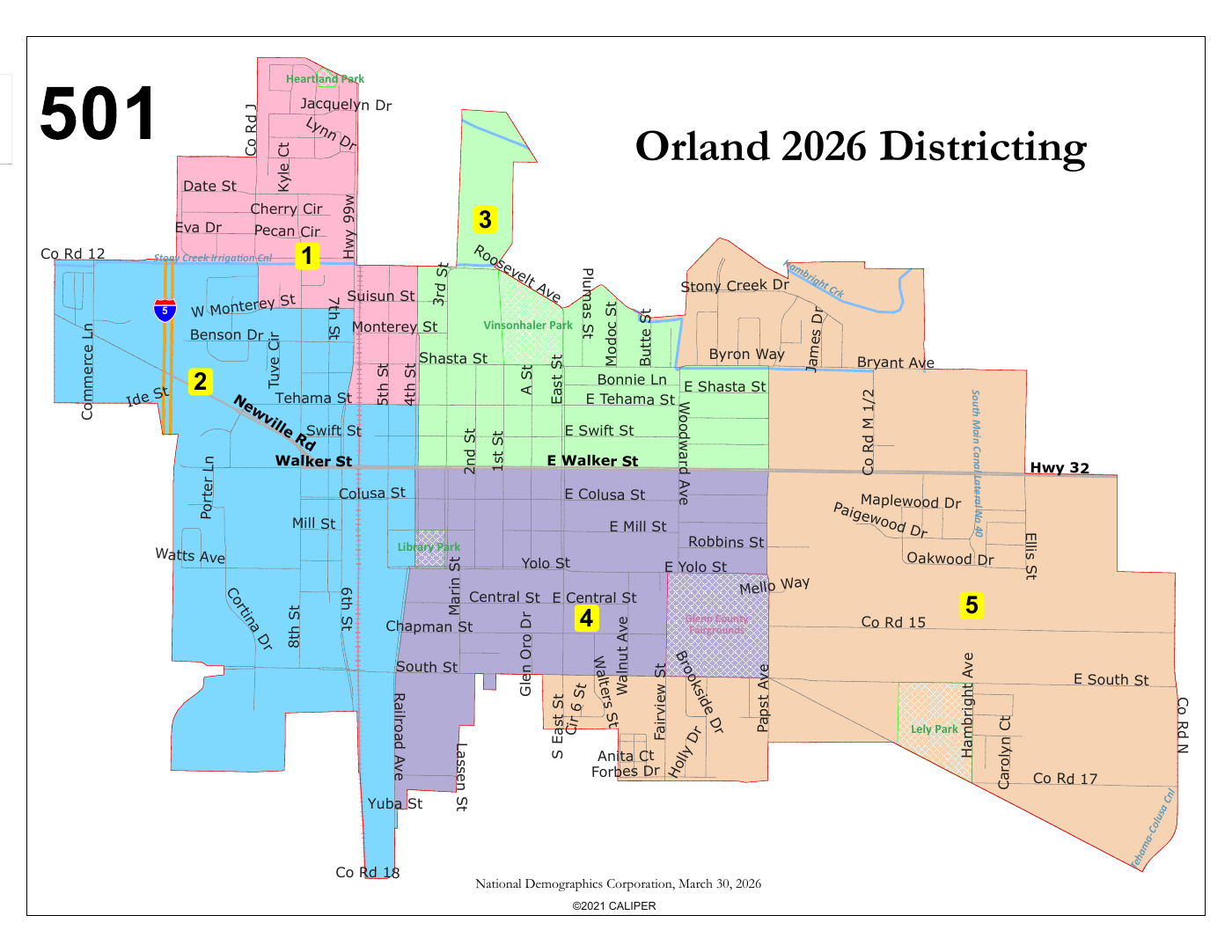
Council selection · May 5, 2026
Each of the five proposed districts would elect one City Council member. District 1 includes Heartland Park and reaches southeast toward 4th Street. An estimated 62% of its voting-age citizens were Hispanic or Latino.
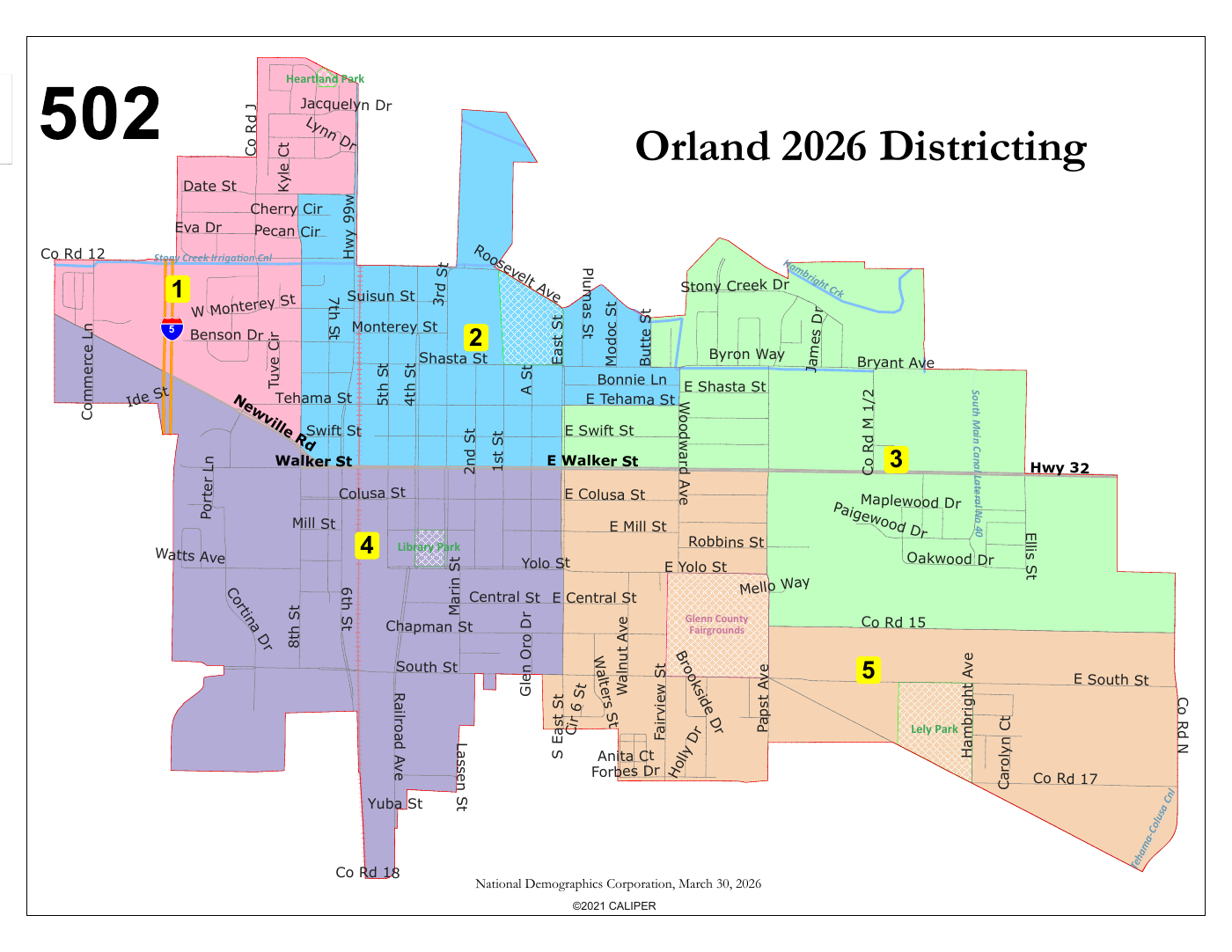
This alternative extends District 1 west across Interstate 5 near Newville Road. Its District 5 includes the Glenn County Fairgrounds and southeastern neighborhoods. An estimated 59% of District 1’s voting-age citizens were Hispanic or Latino.
Zoom in using the City’s interactive map · Browse the City’s draft map archive
| Area | Map 501 Total residents |
Map 501 Latino share |
Map 502 Total residents |
Map 502 Latino share |
|---|---|---|---|---|
| District 1 | 1,696 | 62% | 1,725 | 59% |
| District 2 | 1,594 | 40% | 1,661 | 27% |
| District 3 | 1,625 | 15% | 1,632 | 19% |
| District 4 | 1,701 | 28% | 1,718 | 28% |
| District 5 | 1,722 | 33% | 1,602 | 41% |
| Citywide | 8,338 | 35% | 8,338 | 35% |
National Demographics Corporation’s March 30, 2026 profiles use the 2020 Census for total residents and 2019–2023 American Community Survey estimates and special tabulation data for voting-age citizens. For comparison, 53% of all Orland residents and 66.2% of all residents in Map 501’s District 1 were Hispanic or Latino in the 2020 Census.
The map archive shows earlier election schedules from the hearing process. See the timeline for later Council action.
04 / Legal context
California and federal voting-rights law both matter to Orland. Here are the key developments, checked November 8, 2026.
California law and the courts
The state law protects voters against dilution of their voting power in at-large elections. In 2023, the California Supreme Court explained in Pico that courts assessing vote dilution should consider how voters would fare under a lawful alternative election system. A group can show it has the potential to elect its preferred candidate without making up a majority in a proposed district.
Federal ruling · April 29, 2026
The U.S. Supreme Court ruled that Louisiana’s congressional map violated the Equal Protection Clause. The decision narrowed when compliance with Section 2 of the federal Voting Rights Act can justify using race as the predominant factor in drawing districts. The Court also narrowed federal map-based vote-dilution claims by requiring evidence that strongly points to intentional racial discrimination. The opinion addresses federal law and the Louisiana map. How its constitutional reasoning applies in California remains contested.
State legislation · Signed September 19, 2026
SB 1164 revises California’s rules on vote dilution and adds protections against voter suppression. SB 1360 expands language access for elections. The laws are scheduled to take effect January 1, 2027, with some requirements phased in. SB 1164 keeps earlier liability standards for cases already pending when the changes take effect.
Governor’s signing announcement · Read SB 1164 · Read SB 1360
Trial court update · Reported November 7, 2026
After the case returned to the trial court, Santa Monica cited Callais in seeking judgment in its favor. The Santa Monica Daily Press reported that the judge granted the city’s motion from the bench and directed counsel to prepare a written order. The written judgment and any appeal still need to be verified.
Read the November 7 report · Look up case BC616804 at the Los Angeles Superior Court
California’s separate voting rights law and Orland’s local representation goals give the council reasons to keep working on a lawful district plan. We ask the council to explain how the recent rulings and the new state laws affect the available options.
05 / Source library
Meeting minutes record votes and decisions. Agendas show what was scheduled. Staff reports, maps, and draft ordinances show what was proposed at the time.
City resolution · December 2025
Resolution 2025-20 outlines the City’s intended transition, hearings, and public outreach.
Read Resolution 2025-20 (PDF)Staff report and contract · 2025–26
December’s preliminary estimate was $20,000–$30,000. The January packet shows a $26,500 base and up to $4,500 for additional meetings.
Historical archive · Spring 2026
Draw Orland hosts presentations, recordings, draft maps, and demographic profiles from the hearing series. Its original 2026 election schedule and map deadlines are historical.
Demographer report · May 4, 2026
National Demographics Corporation found that a geographically compact district with a Latino majority among voting-age citizens was possible under its analysis at the time.
Read the Elections Code § 21130(b) report (PDF)Council minutes and drafts · May–July 2026
Read the May 5 map and timing votes, the May 19 draft, and the July 21 vote against introduction.
Read the May 19 agenda and draft
Court opinion and state laws · 2026
Louisiana v. Callais concerns a Louisiana congressional map under federal law. California updated its own voting rights laws in September. The local implications need separate review.
Our community
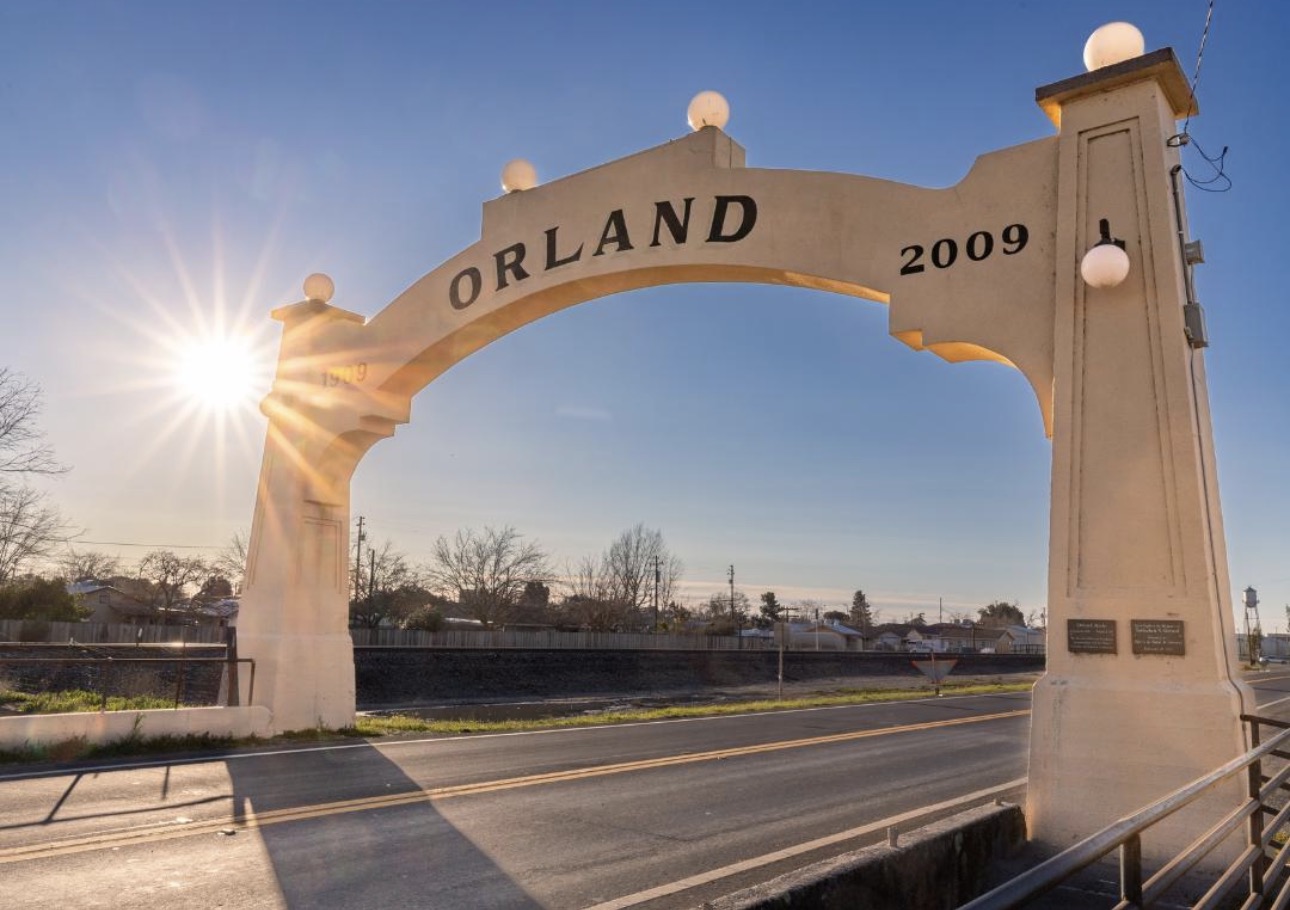
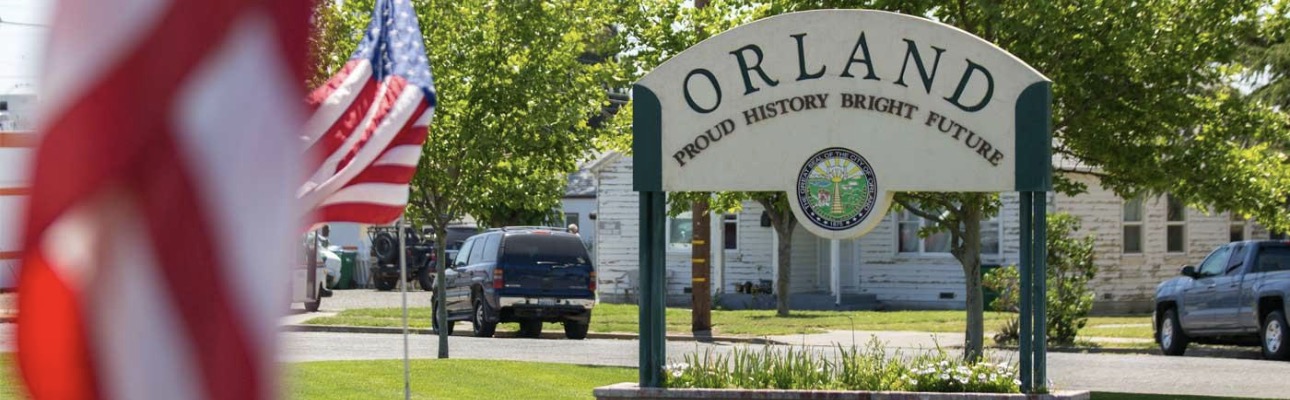
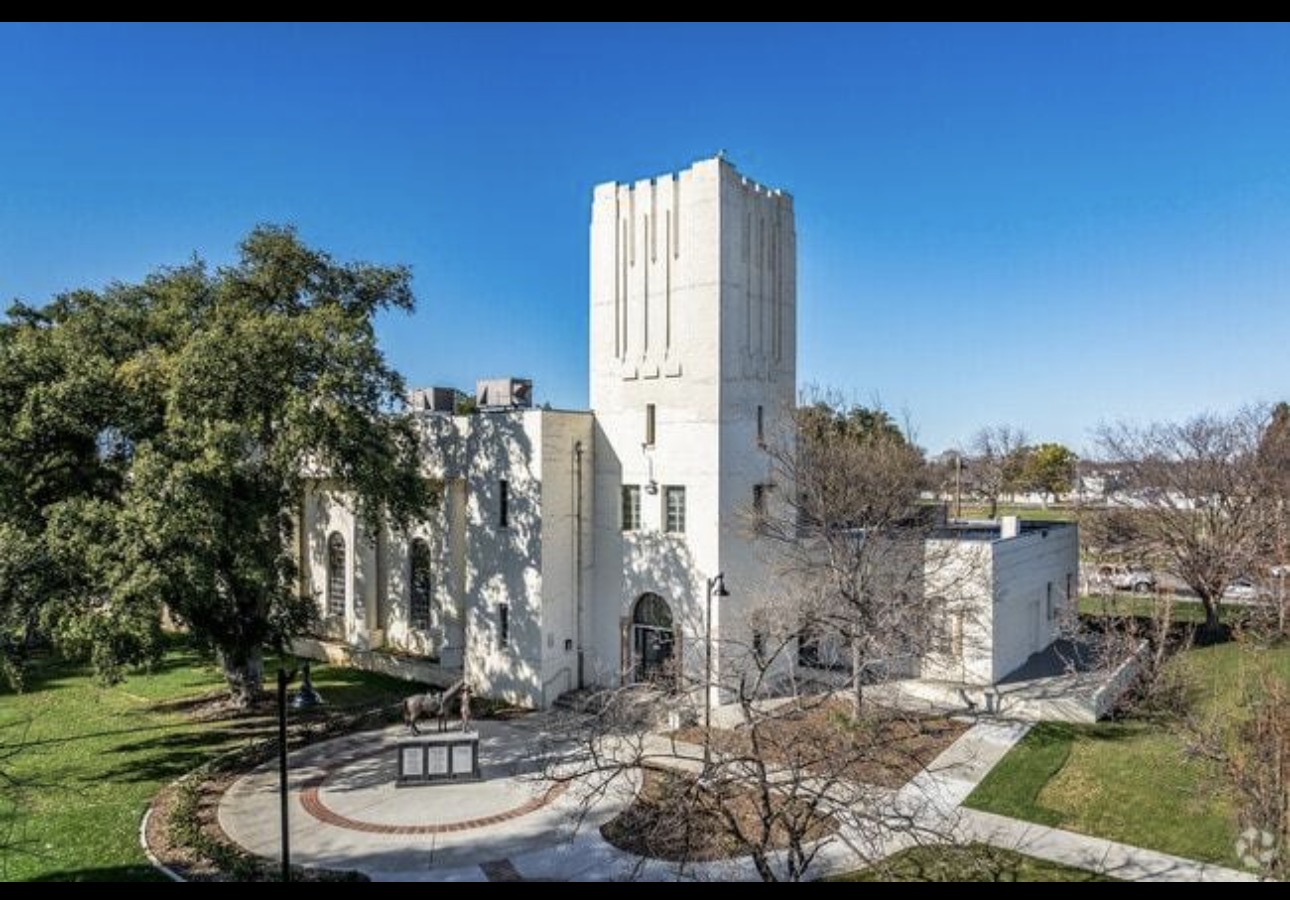
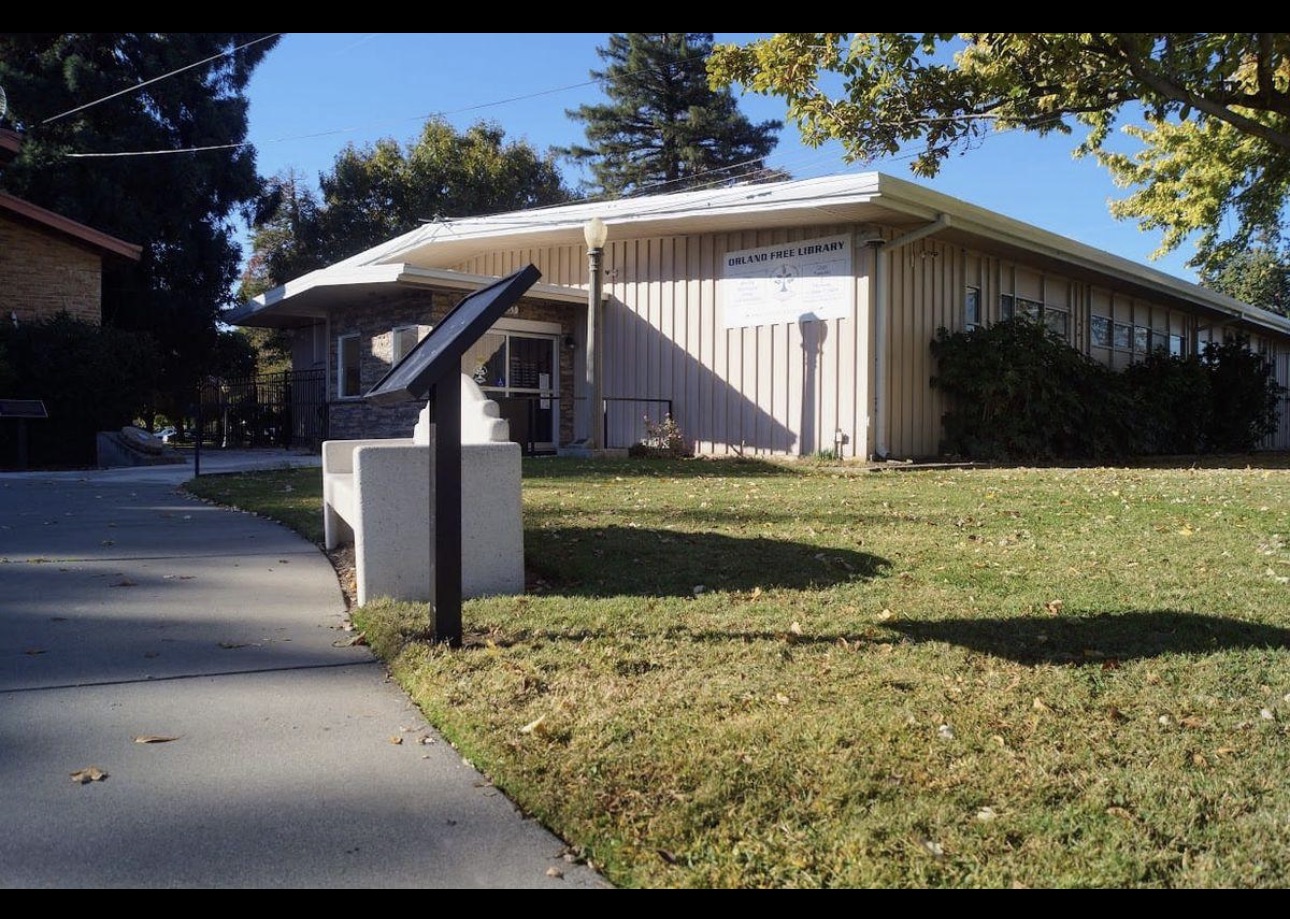
The streets, landmarks, and shared spaces that make this place home.
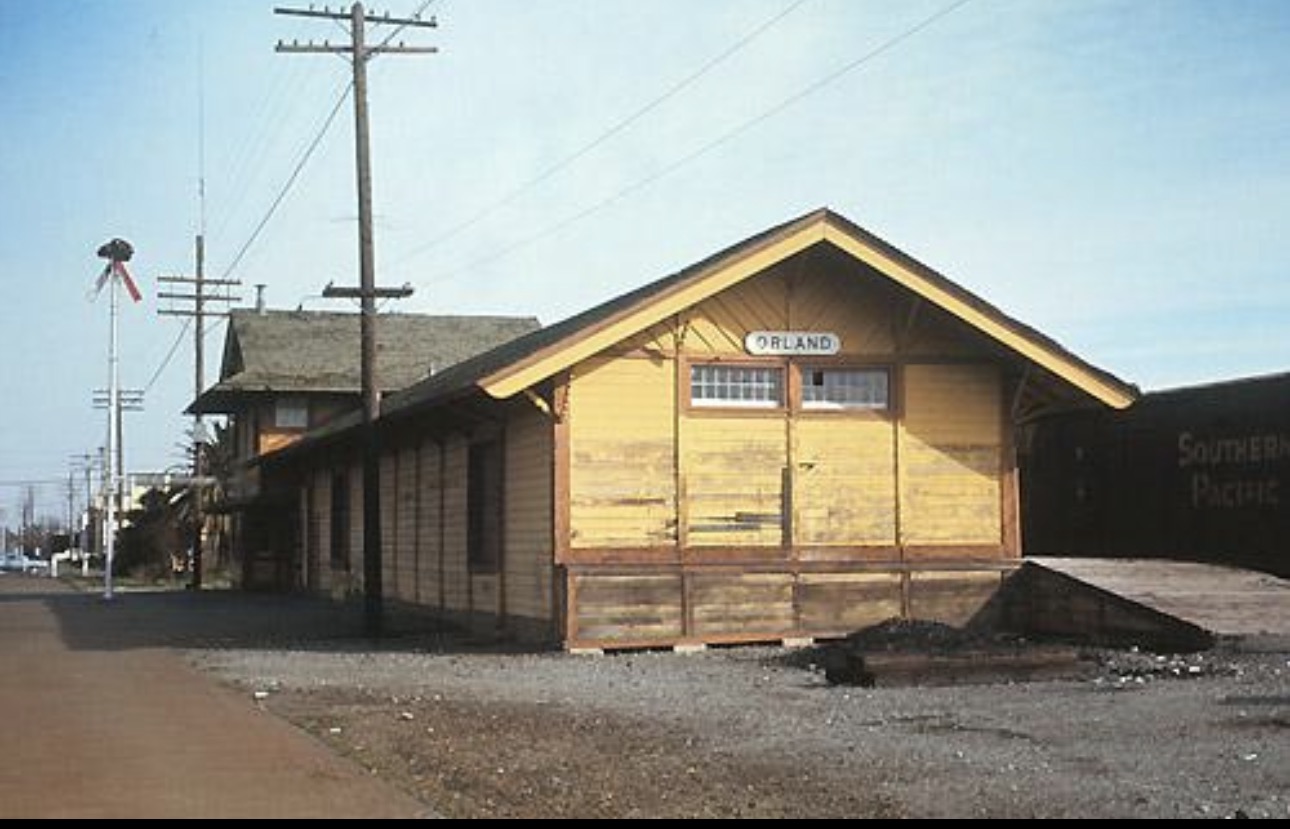
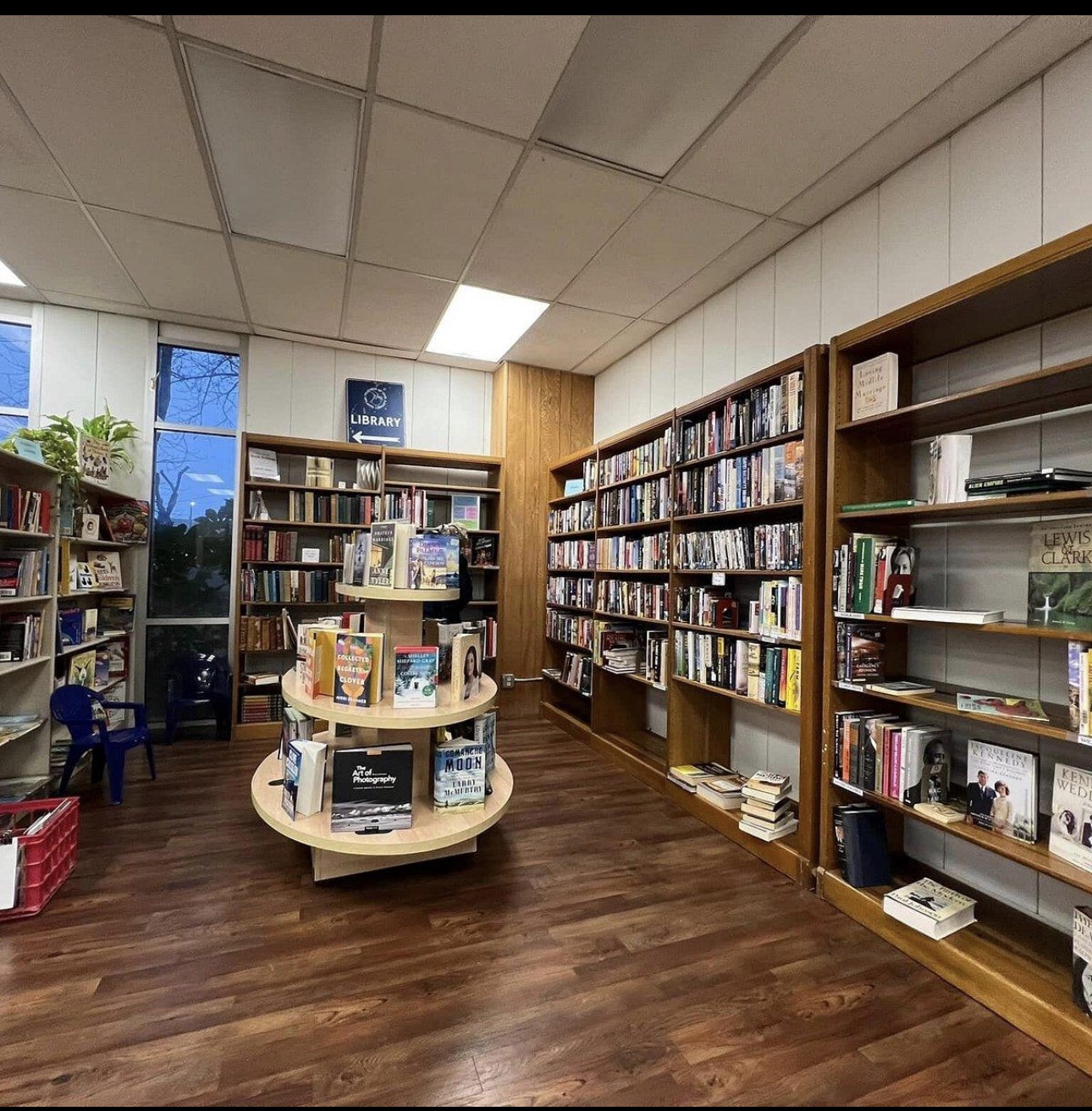
Meet the organizer
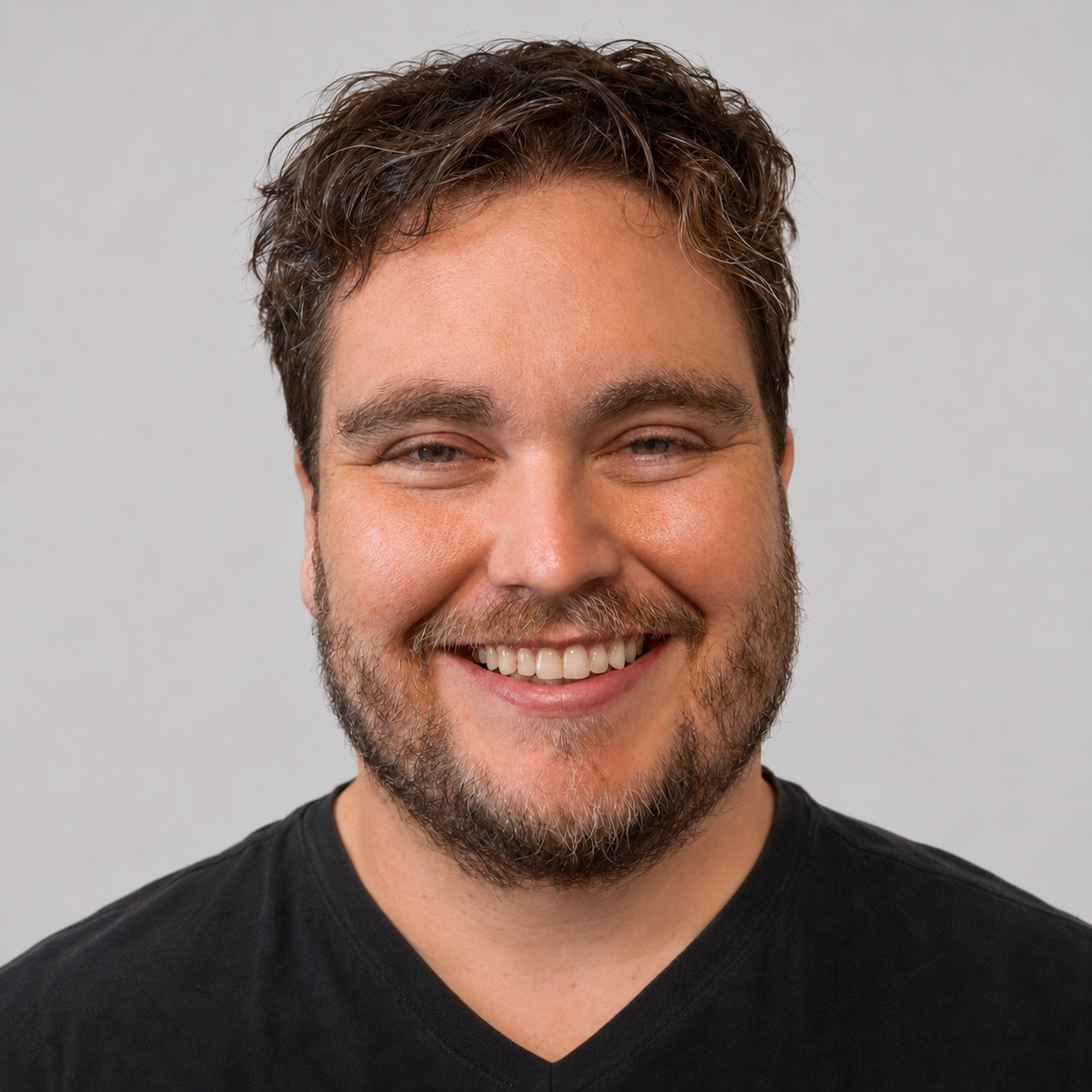
I’m Jake Hackett. I live just outside Orland, and I care about how decisions get made in the community we share. I’ve been following the city’s districting process, speaking at council meetings, reviewing proposals, and working to make the information easier for neighbors to find and understand.
I’m also something of an electoral-systems nerd. But what draws me to this project is a practical question: How do we make local government easier for ordinary people to participate in and hold accountable?
I want people across Orland to feel that they have a place at the council table.
With five single-member districts, each part of the city would elect its own council representative. I believe that could make it more realistic for someone to run by talking to their neighbors, listening to their concerns, and earning their trust.
I care about whether people who have felt overlooked, including Latino residents, have a meaningful opportunity to choose representatives who understand their communities. District boundaries deserve careful public discussion, with residents involved in shaping them.
Changing the election system won’t solve every problem. We’ll still need good candidates, engaged residents, and councilmembers willing to listen. But I believe neighborhood representation would give us a stronger foundation.
Following a local government decision shouldn’t require digging through months of meeting packets.
I started this project to bring the records, maps, votes, and next steps together in one place. I want residents to be able to see what the city has considered, understand what remains unresolved, and decide how they want to participate.
My goal is for Orland to complete a lawful transition to five council districts through an open process with a clear timetable. You don’t have to agree with me on every political issue to join that conversation.
The Orland Districting Project is an independent community initiative. It is not an official City of Orland website.
06 / Participation
Speak to the council, follow new records, or help neighbors understand the proposals.
Open the latest agenda for the meeting location, remote access, comment deadline, and accommodation instructions. Check whether districting is on the agenda.
Find agendas and minutesAsk the council to bring back the district-election ordinance, adopt five single-member districts, and set a clear implementation timeline. Add why neighborhood representation matters to you.
Contact the City ClerkHelp with neighborhood outreach, Spanish-language review, or checking council records.
Contact the project
Open a comment supporting district elections
My name is [your name], and I live in or have ties to [your neighborhood or community in Orland]. I support the Orland Districting Project’s call for five single-member City Council districts, with each district electing its own representative. Residents across Orland deserve a meaningful voice in choosing their council members. [Add a sentence about why neighborhood representation matters to you.] I ask the council to place the district-election ordinance back on an upcoming meeting agenda, move forward with adopting a lawful five-district plan, and publish a clear timeline for implementation. Please explain the remaining steps and provide opportunities for residents to participate, including outreach in Spanish.